
Family-Friendly isn’t Enough to Achieve Gender Equality
This week, posts sourced by the Life Course Centre (@lifecourseAust) are continuing the conversation on social and economic disadvantage as part of Anti-Poverty Week 2026 (@AntiPovertyWeek). Today, Centre Research Fellow Dr Mengxuan (Suri) Li and Centre Director Professor Janeen Baxter explain how achieving gender equality requires more than family-friendly employment structures. It also requires policies that actively redistribute care responsibilities more equally between women and men.

Image credit: Pavel Danilyuk https://www.pexels.com/photo/a-man-talking-to-his-daughter-while-having-breakfast-8763024/ Stock Photo
The Australian Government recently introduced a range of reforms to paid parental leave aimed at promoting gender equality and supporting working families. These reforms included a staged increase in paid parental leave from 22 weeks in 2024 to 26 weeks in 2026, the introduction of four weeks of non-transferable leave reserved for partners to encourage greater uptake of leave by fathers and partners, and the payment of 12 per cent superannuation on government-funded parental leave to help address the long-term retirement savings gap associated with caregiving. These initiatives sit alongside broader workplace reforms, including strengthening employees' rights to request flexible working arrangements, introducing a right to disconnect that enables employees to refuse unreasonable work-related contact outside normal working hours, requiring the Workplace Gender Equality Agency to publicly report gender pay gap data for organisations with more than 100 employees, and implementing the Respect@Work recommendations to create safer and more respectful workplaces. Together, these measures form part of a comprehensive long-term strategy to advance gender equality in Australia.
These reforms are welcomed and while it is too early to accurately assess their impact on gender inequality, they will almost certainly improve the work-family interface for many Australian families. However, whether they will produce meaningful change in gender equality is far less certain. The key question is not simply whether families have greater access to leave and flexibility, but whether these reforms will redistribute caregiving and paid work more equally between women and men.
Our research shows that despite profound social and economic change, men's involvement in unpaid work and care has remained remarkably stable over the last two decades). Parenthood is the moment at which gender equality stalls. It is at this point that gaps in paid work, unpaid care, earnings, mental load, and wellbeing expand sharply, with little evidence that couples ever fully return to parity.
Using data from the Household, Income and Labour Dynamics in Australia (HILDA) Survey, we examined whether paid parental leave and workplace flexibility policies are associated with gender gaps in paid and unpaid work following the transition to parenthood. Specifically, we analysed whether duration of parental leave is associated with gender gaps in hours spent on housework, care work and paid employment using data from three years before to five years after the birth of a first child.
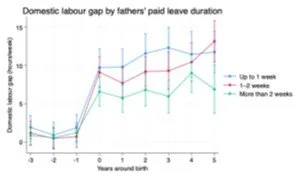
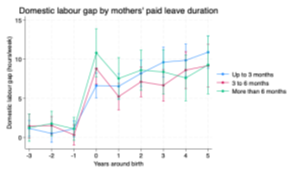
Figure 1: Gender Gap in Housework Hours by length of Paid Leave in the years around entry to Parenthood (Source: Households, Income and Labour Dynamics in Australia survey, 2001-2025)
Longer fathers’ leave is generally associated with smaller subsequent housework gaps. For mothers, longer leave is associated with a larger housework gap around the year of birth, but there is little evidence of a persistent relationship between leave duration and the gap in subsequent years.
While our results suggest that fathers' leave-taking is associated with greater gender equality in housework, the pattern is not consistently observed across all time points. In other analyses we found no significant association between fathers' leave duration and gender gaps in care work and only limited associations with paid work hours.
We conducted similar analyses to investigate whether workplace flexibility is associated with changes in gender gaps in unpaid work before and after becoming a parent. Although workplace flexibility can be measured in various ways, we focus on the proportion of working hours undertaken from home in the previous week. This measure captured location flexibility, a form of work arrangement that has expanded substantially in many labour market sectors since the COVID-19 pandemic.
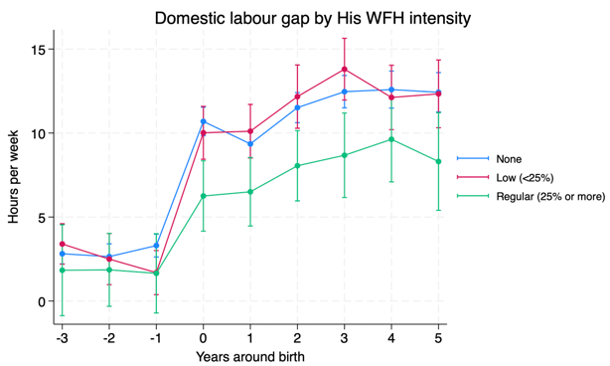
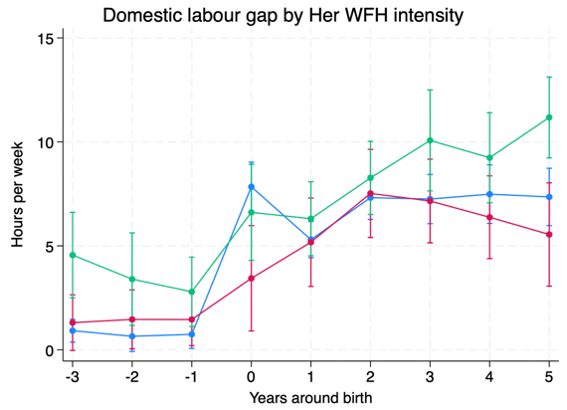
Figure 2: Gender Gap in Housework Hours by Working from Home Intensity in the Years around Entry to Parenthood. (Source: Households, Income and Labour Dynamics in Australia survey, 2001-2025)
The results revealed contrasting patterns for men and women. For fathers, gender gaps in housework hours were smaller when men worked from home for at least 25 per cent of their weekly working hours. For mothers, however, working from home was associated with larger gender gaps in housework. Even though this type of flexibility enables both men and women to do a bit more it does not change the size of the gender gap in unpaid work. These findings are consistent with earlier research that showed the expansion of working from home during COVID-19 often reinforced rather than reduced gender inequalities in domestic labour.
Taken together, these findings suggest that while parental leave and workplace flexibility can shape the division of labour within families, their capacity to transform entrenched gender inequalities is limited. Longer periods of fathers' leave appear to promote greater involvement in some forms of unpaid work, particularly housework, but the effects are modest and do not persist over time. Similarly, working from home may create opportunities for fathers to participate more in domestic labour, but for mothers it can intensify existing expectations around unpaid work and caregiving. These results reinforce a broader conclusion emerging from Australian and international research: family policy reforms can facilitate more egalitarian arrangements, but on their own they are insufficient to fundamentally alter the deeply gendered norms and practices that continue to structure paid work, care and household labour within families.
We argue that policy must move beyond a narrow focus on family-friendly provisions towards a broader gender equality agenda. This requires policies that actively redistribute care responsibilities between women and men, redesign workplaces and organisational practices to accommodate care responsibilities for both men and women and supports equal employment opportunities for all workers. While recent government reforms represent significant progress and we applaud the overall goals, future policy development must place greater emphasis on supporting fathers' active engagement in caregiving and domestic work. This could include increasing wage replacement rates during parental leave, further extending non-transferable partner leave entitlements, strengthening organisational support for leave uptake, reducing flexibility stigma, and fostering workplace cultures that normalise and value men’s caregiving responsibilities. Only by addressing both workplace structures and gendered divisions of care can policy achieve more substantial and enduring reductions in gender inequality.
Content moderator: Life Course Centre