
Kitchen table conversations for place-based disaster preparedness
What if you could sit down over dinner with your mates and get a bit more prepared for the next fire or flood? Katie Moon, Sophie Yates and Elise Remling discuss their concept of ‘relational communities of place’ and how people can draw on existing social connections to improve their own disaster preparedness.
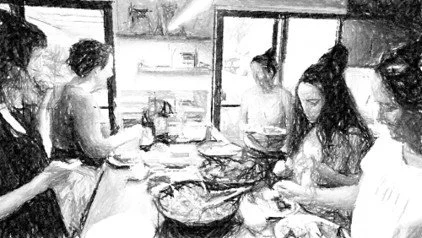
One of our kitchen table conversations focusing on disaster preparedness
Disaster preparedness is as much about social relationships as it is about individual household plans, but organisations and policy largely don’t see it, support it or build on it.
Our new paper details how two of us (Katie and Elise), living in a fire-affected community on the New South Wales Far South Coast, started disaster preparedness instinctively with the relationships we had. Faced by predictions of a dangerous upcoming fire season in 2023, we felt underprepared and so gathered a small group of friends around a kitchen table to have a chat.
After living through the 2019/2020 Black Summer fires, we knew the realities of disaster events and wanted to avoid repeating some of our experiences from last time. And we knew that we could not necessarily rely on government and emergency management agencies to rescue us, keep us informed, or support us the way we needed in the immediate days and weeks before and after the disaster. In our discussions, we kept coming back to the same thing: what had carried us through the past fire disaster was each other. The shared skills, the pooled resources, the person who knew which road was clear, the one with the generator, the one who gathered intel from their volunteer firefighter neighbour.
As we dug into official preparedness materials for the wider community in Australia, almost all were aimed at the individual household, and some at organised neighbourhood or town-level groups. Very little seemed to reflect community lived experience, or the fact that people draw on their pre-existing social contacts before, during and after disasters.
Relational communities of place
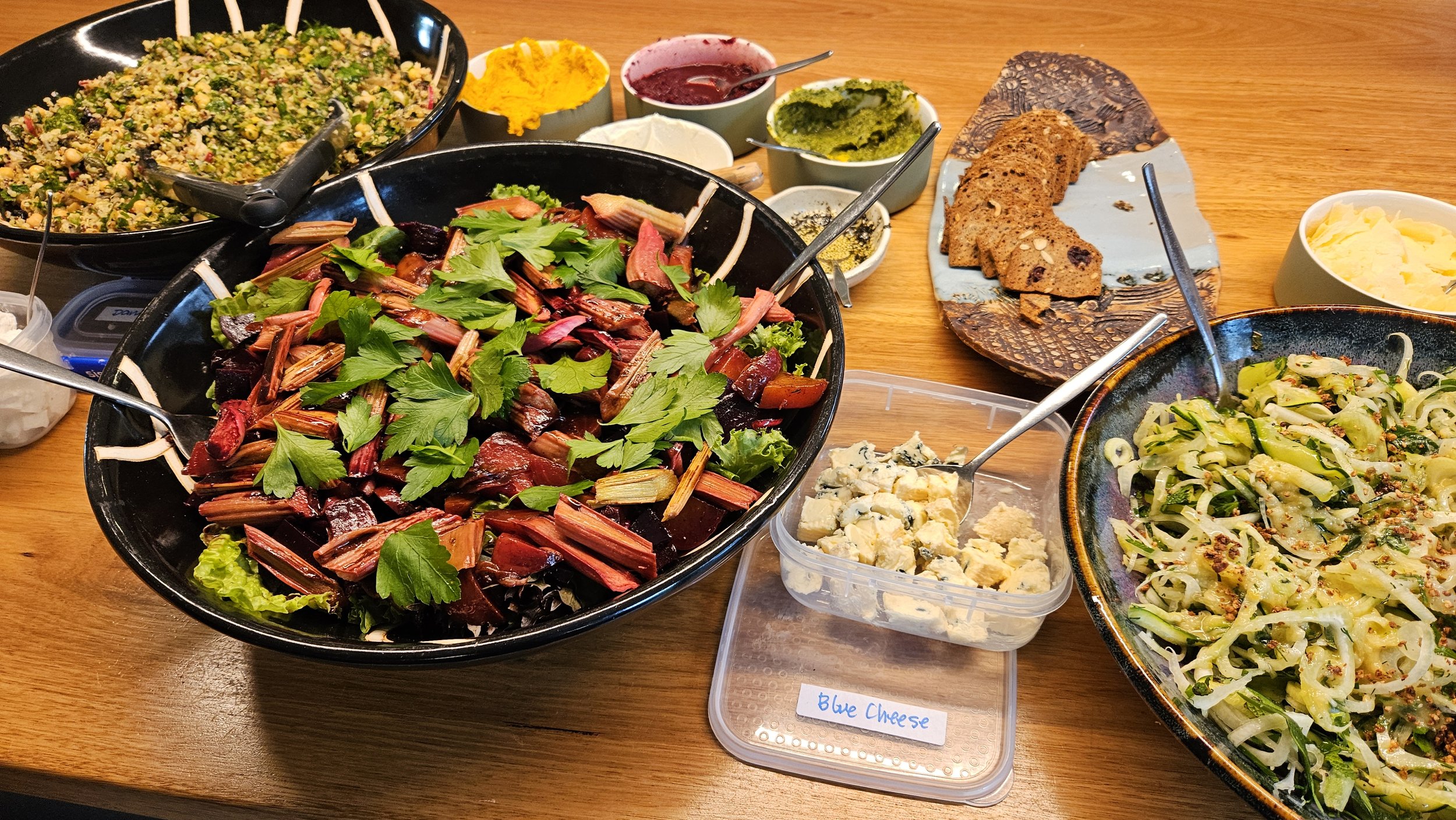
Shared food is an important part of the kitchen table conversations approach - this was our spread in Workshop 1
In disaster social science, scholars often talk about communities of place and place-based interventions – which tend to be defined through co-residence in territorially bounded areas (e.g. neighbourhoods, local government areas), with place treated as a stable spatial unit for planning and intervention. There is also increasingly recognition of communities of interest: organically occurring social networks formed around shared identities, values, activities, or affiliations, such as sports clubs, school groups, faith communities, and friendship circles.
But in our work we wanted to look at both, because from our experience, when disasters happen, people naturally gravitate towards and draw on social networks that don’t always map neatly onto geography. They mobilise relations of care, affiliation, and shared interest that extend beyond a local geographic area. But at the same time, place has a role in shaping social relations. The people who gathered around that first kitchen table didn’t all live in the same town or neighbourhood, but were connected through overlapping place-based social roles, including school, sport, parenting, and shared neighbourhoods.
So we decided to design our model around relational communities of place: socially connected and evolving networks whose relations are shaped by place-based knowing yet not necessarily confined to geographic boundaries.
Building ClimatePods
Our contribution is a practical way of thinking about how to draw on pre-existing social connections to prepare together for disasters and extreme events. We came up with the term ‘ClimatePods’ as a practical and accessible way of naming the kinds of small, relational groupings (‘pods’) that formed the basis of our work. The term ‘climate’ indicates that this is not one-off work but will be useful as climate-related extreme events increase.
We secured a seed grant from ANU and built on those initial informal meetings to design some tools and checklists for disaster preparedness, testing them out with a couple of workshops in the fire-affected Eurobodalla region of the NSW far south coast. Participants already knew each other, and lived across several towns and rural properties. Each time we organised local catering and shared a meal together as we discussed the approach and the tools. Then the research team revised the tools and approach based on feedback.
A phased and flexible approach
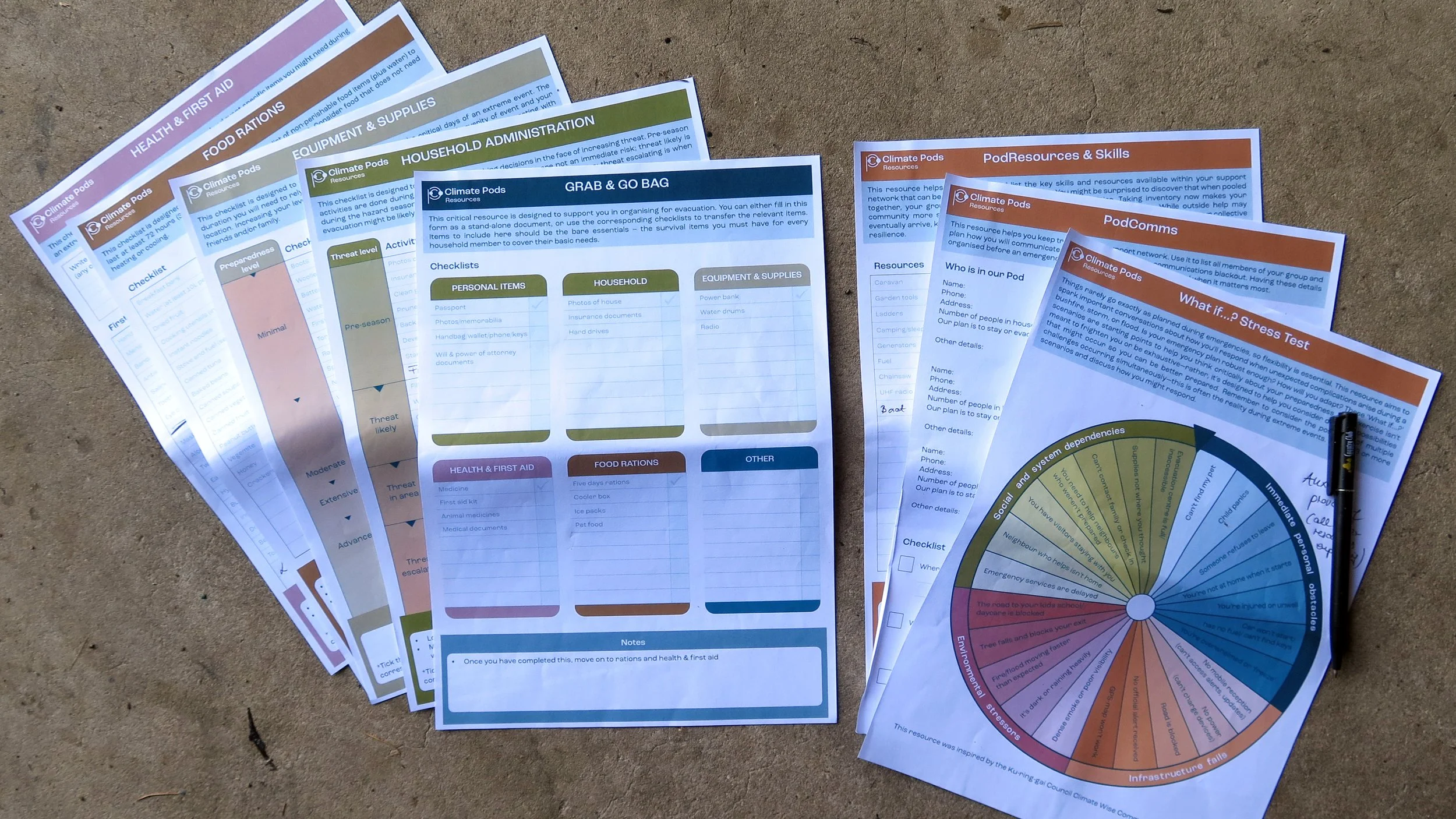
The ClimatePods toolkit
Our model recognises that you do need to get your own house(hold) in order, but that it helps to share ideas with your ‘pod’ while you do that. It also recognises that you may want to work with other people to pool resources and share skills and plans, to gain strength in numbers. So our tools do both.
First, we suggest that people fill out some individual household-level checklists, and then get together to discuss them all. Our workshop findings suggest that this coming together leads to shared learning that is more useful than what would happen if people prepared their plan alone.
After that, groups can move on to discuss shared activities – like skills and resources that exist within the group that can be shared, how they might get in touch with each other if communication systems go down, and events such as working bees to get each other’s houses disaster ready.
The result is a simple method and a set of resources for small, trusted groups doing preparedness planning together.
Access the Conversation Guide and all the resources, and our open access paper in Environmental Sociology.
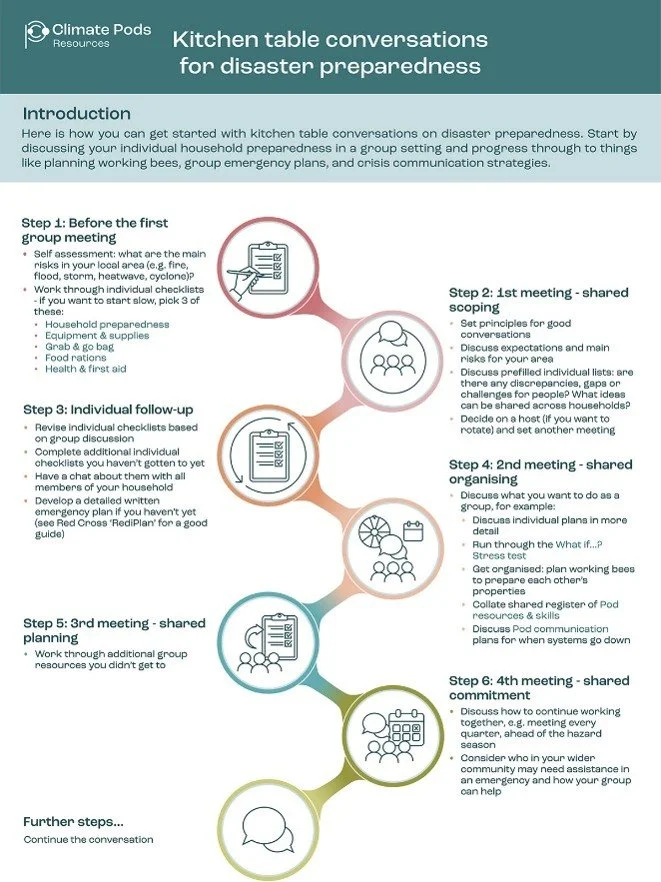
Our suggested phased approach to kitchen table conversations
We gratefully acknowledge our funders (the ANU’s Asia-Pacific Innovation Program) and the workshop participants for their heartfelt and insightful contributions and their time and energy. We also acknowledge the traditional owners of the lands of the Walbunja people of the Yuin Nation, where we did this work.
Source: Moon, K., Remling, E., & Yates, S. (2026). Kitchen table conversations as a social technology for place-based disaster preparedness. Environmental Sociology. https://doi.org/10.1080/23251042.2026.2668514
Content moderated by Sophie Yates