
Aged care assessment tool is pronounced “flawed,” but reflects a dysfunctional system
After an unprecedented number of complaints about the recently-introduced Integrated Assessment Tool (IAT), the Commonwealth Ombudsman investigated. Recently the report was released which found fundamental flaws in the transparency, oversight and legal framework for the IAT and the assessment process within which is it situated. In today’s post, Dr Susan Maury of MND Australia reflects on the Ombudsman’s report and also what has been left unexplored in aged care, which points to profound and fundamental dysfunction.

Photo by micheile henderson on Unsplash
After the scathing findings published from the Royal Commission into Aged Care, the Commonwealth Government introduced a revamped My Aged Care in November 2025. It was intended to address systemic failings, placing human rights at the centre of the model and reflecting choice and control, fairness, transparency and accountability.
In my role with MND Australia, I have spent a lot of time analysing aged care and how fit for purpose it is for older people with motor neurone disease. Previously, I spent many years analysing how the welfare system systematically undermined women’s financial security, and how these settings seemed to be deliberate. I am in new space now, yet the parallels with Aged Care are eerily similar.
What is wrong with the Integrated Assessment Tool?
The government introduced the Integrated Assessment Tool (IAT) to standardise assessment outcomes and ensure they are consistent and fair. They have described the IAT as the “integration of validated tools for an assessment with depth and clinical rigour” and say it was developed with extensive consultation, “including geriatricians, clinical assessors, peak bodies and older people.”
Despite these claims, our analysis showed that, for people living with MND, their assessment outcomes ranged from the highest to the lowest packages. This is surprising because of the nature of motor neurone disease. Despite the high profile of MND in Australia, it is a poorly-understood disease in which the motor neurons, which control muscle movement, progressively weaken and die. While progression can differ, people living with MND eventually lose the ability to walk, use their hands, speak, breathe and swallow. There is no cure and it often progresses very rapidly, especially for people diagnosed at older ages. Care for someone with MND, particularly as the disease advances, is onerous and expensive, often involving wheelchairs, hoists, communication devices, feeding tubes and non-invasive ventilated breathing assistance. While there is, of course, a spectrum of need, because of the rapidly progressive nature of the disease most older people with a diagnosis of MND have very high care requirements. For this reason, the outcomes from IAT assessments are surprising; see Table 1.
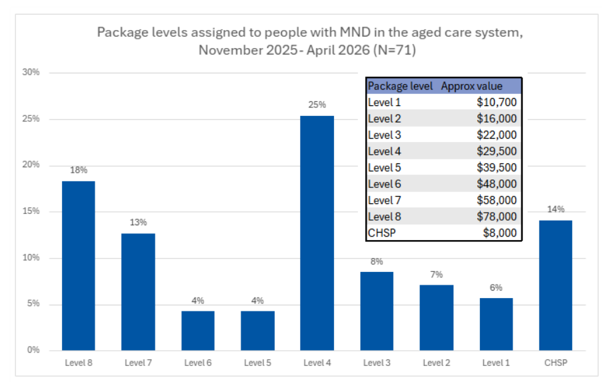
Table 1: Aged Care package levels assigned by the IAT for people with a diagnosis of MND, November 2025 – April 2026 (N=71)
Importantly the Ombudsman did not asses the clinical competence of the algorithm, although the Australia and New Zealand Society for Geriatric Medicine has said that “the IAT does not consistently reflect the biology of ageing, the realities of multimorbidity, or the fluctuating trajectory of frailty” and therefore “risks systematically under-identifying frailty, functional vulnerability and clinical complexity in older people.” What the Ombudsman did report was that, due to multiple failings in both the tool itself and how it is used by the workforce, “a reasonable person would… lack confidence that the system is in fact fair and consistent” (p. 11).
They also refer to the IAT as a “black box” without any public-facing explanation of how it reaches decisions. Prof Kathy Eagar, an expert in health services and funding models, recently explained how the IAT works to the Support at Home Inquiry. She walked the Committee through how the branches of the algorithm are faulty, how it fails to ask critical support questions until too late in the process, and how just a 1-point difference in a sub-score can result in a $40,000 difference in approved support packages.
What else is going on with My Aged Care?
The IAT is definitely a problem. But we recently worked with the service managers at the MND State Associations to create a journey map of the aged care system for people living with MND. State Associations provide direct services to people living with MND, and assist with service navigation. Their analysis reveals deep systemic issues. The IAT is only one part of a fractured, broken system.
For example, the assessment process does not consider decline. Excuse me, what? That’s right; the system that supports over 1 million older Australians assumes that their health will not deteriorate. Of course, there are many Australians who age well and may go for years without needing intensive support. But for the 80% of Australians aged 65+ with at least one chronic health condition, it seems like a strange assumption, and for those with a progressive, life-limiting disease like MND it is cruel. As-needed access to reassessments would mitigate this problem, but unfortunately reassessments are restricted and can be denied.
There are also difficulties accessing both respite and permanent places in residential aged care. Residential facilities can decline entry to any applicant, and for people living with MND they are often ‘clinically declined’ because their care is so complex. While cost structures for residential care includes higher daily payments for more complex residents, the price differential to people requiring more standardised care is insufficient. Many residential facilities are unable to provide clinical care in any event. This means many people living with MND end up in hospital when they cannot remain at home, creating ‘bed block’ and often compromising safety and care.
Another major concern is the assumption that there is a capable family member who is the main care provider. For many older Australians, their carer is their partner – who is generally also older and also facing any number of health concerns themselves. In some instances children are leaving employment to look after their parents.
My Aged Care facilitates financial stress
A major concern is the financial burden that the program puts on the households of people who are living with MND. Financial stress comes in many forms, compounding through such avenues as:
Inadequate funding for assistive technology and home modifications. While the budget for each is up to $15,000, they are one-off payments and cannot be combined to cover off expensive items like an extensive bathroom remodel, which is something most people living with MND will need. Non-invasive ventilation is excluded from assistive technology funding. As the only demonstrated method to improve and lengthen life for people living with MND, this exclusion seems both arbitrary and clinically indefensible. People who can afford to will purchase a ventilation machine themselves, at a cost of about $5,000.
No regulation for Provider fees. Our analysis (pp 29 – 35) found that aged care providers were charging between 35% – 51% higher fees from pre- to post-reform (1 November 2025), when caps were removed from fee structures. We also found that people reliant on aged care were paying between 24% - 94% more than participants with the NDIS, which has price caps, for identical services.
Providers also charge an administrative fee for processing payments, which can only be processed through them. These administrative fees can be extraordinarily high and are paid out of individual package amounts.
The co-pay structure, which can create barriers to accessing support.
Accessing respite care often requires booking a minimum of 2 weeks, creating excessive expense if only needed for a few nights.
Unwanted hospital stays can also come at a cost, sometimes up to $85 per day out of pocket.
Most importantly, for people with MND package amounts are inadequate even at the highest levels. A Level 8 package is approximately $80,000. Families tell us this covers about one-third of care costs for people in later stages.
The government has not looked at how the aged care system places financial pressure on households at multiple points. A system which is intended to support older Australians may instead be creating unsupportable financial stress.
We need to do better
Taken together, it is difficult not to look as the systemic issues that are built into the My Aged Care model as purposeful. Is this a reflection of how we now value older Australians? Like the welfare system, there may be assumptions that people who are accessing aged care are ‘unproductive’ members of society who are being punished for placing strain on government budgets.
My Aged Care should provide the required level of support for each individual, rather than expect them to fit their needs within meaningless budget categories. It should be easy to access. Respite and residential care should be viable options. Funding to ensure people can remain in their homes for longer needs to be adequate to cover changing needs. This is a human rights issue.
Moderator: Megan Lang