The middle of our Venn diagram: Research partnerships with the disability sector
How can we partner well to deliver impactful disability research? This post is an edited summary of a panel discussion hosted by the researcher development program of the NHMRC Centre of Research Excellence in Achieving Health Equity for All People with Disability (AHEAD). The session was attended by AHEAD researchers and affiliates, to give them a chance to hear a senior academic and a disability sector leader talk about the increasing imperative to partner, and the opportunities and challenges of research partnerships. Panellists were AHEAD co-leader Professor Helen Dickinson (UNSW Canberra) and Maeve Kennedy, CEO of Inclusion Australia, and the session was facilitated by Dr Sophie Yates (ANU).
Introduction
SY: AHEAD’s goal is to enhance health equity by implementing sustainable co-designed solutions that address the social determinants of health for people with disability. Our key research topics at AHEAD are housing, NDIS, healthcare and employment. But today's topic is something fundamental to them all, which is research partnerships with the disability sector. To do the research to get the evidence we need to improve policy in any of AHEAD’s priority areas, we increasingly need strong partnerships with the sector. In fact, the National Disability Research Partnership (NDRP) now mandates partnership between at least two organisations and heavily emphasises community involvement.
Aimed at disability researchers, this panel explores why we partner, how we partner, challenges and opportunities, and what not to do when building relationships with disability organisations.
Panellists

Maeve Kennedy
Maeve Kennedy is the CEO of Inclusion Australia, the national representative organisation for people with an intellectual disability and their families. She brings over a decade of experience in disability advocacy, social policy, and government relations. Since joining Inclusion Australia in 2022, Maeve has led key initiatives focused on human rights, supported decision-making, and inclusive employment. She works closely with government and sector partners to ensure the voices of people with an intellectual disability shape policy and system reforms. Maeve is committed to inclusive leadership and creating meaningful outcomes through collaborative processes that draw on the diverse skills and perspectives of individuals and communities.
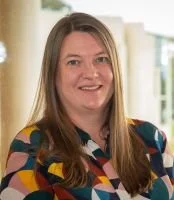
Helen Dickinson
Helen Dickinson is Professor of Public Service Research in the Public Service Research Group at the School of Business, University of New South Wales, Canberra. Her expertise is in policy implementation and evaluation, with a particular interest in disability policies and programmes. Helen has published twenty books and over one hundred peer-reviewed journal articles on these topics and is also a frequent commentator within the mainstream media. She has worked with a range of different levels of government, community organisations and private organisations in Australia, UK, New Zealand and Europe on research and consultancy programmes.
Why we partner
What is it in our research funding infrastructure which increasingly puts an onus on researchers to work in these partnerships?
HD: I'm not sure the pressure for me has ever come from the research infrastructure and is more of a principle of how you do research. And in the disability space, even those of us who have elements of lived experience, they're partial insights, right? The element of lived experience that you have is not representative of the diversity of people with disability. So I think to me, it's always been really important to make sure a), that we ask the right sorts of questions and that we do that in the right sorts of ways. But also really importantly for me as well, b) something about research translation, knowledge, mobilisation, whatever you want to call that. If academics just work on their own they’re not going to see their findings and insights be picked up.
So to me, it's really good to see the research infrastructure starting to respond to this in a limited way. Australia’s starting to catch up, but it's catching up very slowly. And I think if you look at some other countries, like I'm very familiar with the UK system, having worked there for a long time, there is much more of a requirement around particularly a lot of their human services research funding, for you to be really explicit about how you've engaged with end users or others through your process of research and talking about how it will impact on that.
Now, we don't have the same sort of level here unless you're going for National Disability Research Partnership funding or a couple of other specific streams. But it can be a good thing in terms of things like ARC, NHMRC, those sorts of streams, to be able to start talking about impact. So there's a real focus for a lot of universities and for research funders at the moment is to say, well, we know that there's a lot of really good quality research that goes on in Australia, and a very small proportion of it is translated into practice. So that's a real focus across the sector at the moment. And so if you're writing an early career fellowship, and one of the points you're making is that you think this is going to change policy and practice, you can talk about that in a really broad way. And your reviewer might say, yeah, maybe it will change practice. But if you write about it saying, “I've already been working with this array of different partners on things such as this”, and you can provide examples of either some of the stuff you've done or some of the change, it just gives it a greater degree of credibility that you can name and you can show some of that track record. So I think in terms of the policy/practice impact and about showing about how you research something in practice, that's a real space where some of the partnering is potentially really advantageous as well.
Why is it important to include people with disability and disability sector organisations in disability research?
MK: So first of all, from our perspective, it's the right thing to do. We're probably all familiar with the self-advocacy motto of “nothing about us without us”, which means that people with disability have the right to be involved in decisions about their lives and also therefore in research about them. But it's not just that it's the right thing to do, it also leads to better research. So people with disability are experts in their own lives and experiences. They know what works well and where the challenges are. People with disability bring expertise that researchers don't have necessarily and can help identify the questions that really matter. They can also challenge assumptions that researchers may not even realise that they're making.
Involving disability sector organisations is important because our organisations bring practical knowledge at a systemic level, so about the systems, services and community priorities based on working closely with our communities over many years. In Inclusion Australia's case, that's 72 years this year. Sometimes researchers think of disability organisations primarily as a way to recruit participants. But the biggest value people with disability and sector organisations bring comes earlier than that. It's about shaping research questions, methods and interpretation of findings so that the research can reflect community priorities from the beginning.
HD: I agree with all of that. And I always learn – the number of times I gain hugely from just having a phone call with Maeve, who's close to what's happening in the sector and the politics around some of that, but also close to community perspectives on stuff as well. I will always come away from a conversation with Maeve with three more different ideas about things that are needed and would be good to do. And it's just so valuable in moving away just from what the literature says, which is inevitably a couple of years behind wherever we are, right? Because that's the way that publishing happens. And really getting that closer perspective is just so valuable and does improve the research that we do as well.
From your observations over the years, have inclusive research practices improved?
MK: From our perspective, there have been really significant changes over the decades. So 20 years ago, if participation happened, it meant being a research participant, people with disability as subjects. Then we've moved towards seeing more consultation where people with disability have been asked for their views on research and been involved in recruitment or advisory groups. More and more lately, although it's still not consistently done, is a greater focus on co-design, figuring out what co-design really means in research, and a focus on partnership and even disability leadership. And Helen mentioned the NDRP, and that's certainly one of the mechanisms at the moment.
So from an intellectual disability perspective, for example, we have really good examples now of people with intellectual disability working as genuine co-researchers in paid roles. We're seeing funding models start to recognise that genuine inclusion takes more time and more resources. The NDRP, for example, is creating structures specifically to support the costs of co-design. We're also involved with the National Centre of Excellence in Intellectual Disability Health, and the Centre for Inclusive Employment, which is at Swinburne University. And there are examples with both of those initiatives of disability leadership in practice.
Again from Inclusion Australia's perspective, we're probably seeing the inclusion of people with an intellectual disability being a little bit slower and takes longer than inclusion in other parts of the disability community. So I think that's an interesting thing for us to think about. Sometimes we find that there'll be broad progress across the disability community, but if we unpack that, it's different in terms of different cohorts or different parts of the community. For people with intellectual disability, it takes more time and more resources and really often specialised skills to do co-design well. It's not that it's that only some people can do it. It's about taking the time and learning the skills. We need to better recognise and invest in what good inclusion actually looks like and what that means for different parts of the disability community. It's not just a one-size-fits-all.
HD: I think there’s a greater degree of understanding of why you would engage people with disability in research and what the benefits of that are, and fewer questions in navigating things in universities like HR and ethics and things like that. One project we did around 11 years ago, we employed a bunch of researchers with disability to be the researchers on that project. It was a really great project and a really great bunch of people who have been proper political agitators since then as well. But we did have to fight a lot of arguments with HR and ethics, for example they told us we had to have two different ethics applications, one for the co-researchers and one for the project. So I think now there's a greater degree of understanding broadly of what it is and why it's important, although we don’t always get it right.
Challenges in partnering
While recognising that it does make research better, is it possible that we’ve gone too far in putting pressure on everyone to partner all the time? Are we being so inclusive that it constitutes an extra burden on the sector?
MK: I think it's a really interesting question. From our perspective, the structured opportunities and incentives around co-design have been really important in this space, so Inclusion Australia and our members and lots of other organisations working in the peak and the advocacy space in the disability community. We usually find out when there are big research applications coming up very soon because we get a flurry of invitations to be part of things. We see such a variability in the way that we're approached and in the way that that's understood – even when co-design is structurally incentivised, like through the NDRP. Sometimes it’s very last minute, and “can we just put your name on” or “could you just join our steering group?” Sometimes earlier, but with the entire brief and idea already written and it's an e-mail and it's just, you know, “we think you'd be great to join this”, or “get back to us in the next week”, or “could you write a letter of support?”
The best cases are where people come to us really early and say, “we'd love to do something in this kind of area. We bring this experience or this expertise. How does that sit for you? Is that something you're interested in? What are the opportunities from your end to have those conversations really early?” Clearly that takes a lot of time. And that's where having relationships like this and longer term partnerships where we know each other over time and we can talk about that earlier, they're really helpful.
But I do think that what ends up taking the most time and being the biggest impost on organisations like ours, it's not the good co-design approaches. It's the last minute, “could you just sign on to this”. Like for one of the research rounds last year, we were juggling, I think, seven invitations to be part of different things. So we then need to set up an assessment process. How do we figure out what's good? How do we figure out what will genuinely include people? What are some of the things that we look for there? Some of it you can tell, as in I'm not going to say yes two days before the grant application is due and you've already fully scoped it. But sometimes it's harder because if we want to prioritise our time, where should we invest that? So it's been a really interesting process. And I think even from outside, in the last three years in particular, and that probably is a little bit driven by the NDRP. There has been a notable difference and a lot more active engagement earlier and in more of what we'd call genuine co-design. And then I think it's the other broader, less specific grant rounds where we see such a degree of variability, where someone might come to you where it's fully conceptualised already.
And then we still get a lot of requests to recruit, and to share opportunities with participants as well. So that takes resourcing and again, that kind of assessment from our end, testing the purpose, testing the genuine commitment to working with people, not conducting research on people. So there's a lot of that review, decision making, testing at our end.
HD: I'm really heartened by what Maeve was saying there about the quality of approaches and people starting to think about that sort of stuff earlier, which is good. And it sounds like some of the capacity building gaps in academia are starting to be filled. And I think it's tricky, isn't it? Like, it's really difficult for academics, how do you learn how to do some of this sort of stuff? Because nobody does it right the first time. I still get it wrong all the time when I do this stuff, because, you know, they’re relationships, right? And they're human interactions. And finding the space to do some of this sort of stuff can be really difficult. We know particularly what early career workload pressures are like. You've got to write, you've got to get grants, and relationship building isn't necessarily always high on those lists of things to do, when there's no guarantees of success from that and you're being pushed in a number of different directions.
And I think that points to the importance of finding teams who do some of this sort of stuff and seeing if you can join in some way, without necessarily having a lead role. I learned to do this by working with people who did a lot of this. And I went and sat in on an awful lot of meetings and discussions and did a lot of that sort of stuff before I started being successful in this sort of space. And it really does take quite a lot of capacity building. So I'm worried that some of that's getting squeezed out, given where we are at in the context of higher education at the moment. But I guess I would say to people, if this is the sort of research that you think you want to be doing and you want to be investing in, then really seek out some of those teams and see if you can join some of those, if you can get involved in some of the communities of practice, or even just do stuff like make sure you've signed up for the newsletters for DROs [Disability Representative Organisations], because from that you find out a huge amount about what kind of priorities people have, what they're thinking about and where some of the opportunities might be. So there's lots of information out there, find different ways to access some of that.
Building relationships
For researchers who are just starting out or may not have great networks yet, what’s the best way to go about building the relationships that turn into partnerships?
MK: It's such a good question and I think the reality is that helps so much. In terms of that assessment and consideration at our end, having an established relationship really makes a difference. And some of it is around trusting that longer term approach and meaningful involvement. And I guess we know nobody is perfect and we're certainly not perfect in the way that we do inclusive work and co-design ourselves, but it's about that genuine commitment. From our perspective, I think what I've found personally quite helpful is a broader interest in our work, and sometimes that means turning up at sector events. So Inclusion Australia, we have eight members, one in each State and Territory, and four of those members run an annual conference. Sometimes research is presented, sometimes it's not, but it's such an opportunity to meet people. So for those conferences, the audience is people with intellectual disability. So they are real chances to talk to people and there are a lot of capacity building workshops and also just fun events. We tend to do a lot of discos. So coming to those kinds of events, that's a way, and through the Australasian Society of Intellectual Disability, and ASID events. They're two of the ways that I've met people and been able to build those kinds of relationships.
I think definitely seeing people coming to our kinds of things and being curious and open is such a good sign. And I know that that's such a big time commitment, but coming along and listening and getting a feel for how we do things and what co-design can look like is really helpful. Working with people with an intellectual disability in particular is very relational and a lot of it is about face to face and showing up. People are really good at calling bullshit. Apologies for my language, but you know, being genuine, being open, and being warm and curious are really helpful things.
The other part of it is through networks as well. So we support a group at the moment that is focused on parents with an intellectual disability and partnerships between advocates, researchers and parents themselves. That group meets every couple of months. And so it's those kinds of informal networks as well. I'd say a big part of it is connection with advocacy organisations. It's not just Inclusion Australia, but it's wherever you are, what's happening locally. Are there organisations that deliver individual advocacy services? There's a great list of those organisations on the DANA website, the Disability Advocacy Network of Australia, as well as the peak bodies. There tend to always be events happening.
And I think building up a little bit of that street cred in a sense can really help where you just get to meet people, and then if a request comes in, we will sometimes ask around and say, “this project sounds really interesting. Have you worked with these people before?” So having that broader network can really help as well.
I think it's also thinking about how research can contribute to advocacy goals because our organisations are advocacy organisations and we have priorities and work to do there. So it's always incredibly helpful to have people drop into your inbox and say, “hey have you seen this report?” Or like, “I loved that media piece” or “I saw this in your newsletter. Have you thought about this?” Those kinds of connections are so helpful, because that's where we have that shared priority. That's the middle of our Venn diagram.
HD: I guess the other way you develop experience and track record in working with DROs, it doesn't necessarily need to be through funded research. So Maeve, I think the first project we worked on was where you collected a bunch of data, but didn't necessarily have the time to analyse it in detail. And we came along and said, really happy to do a bit of pro bono work for you, but we would expect to be able to publish out of that. And so it wasn't funded, we put our time into that, but we did get a couple of papers out of it. And also out of that we were able to say we've got this track record [of working together] here as well.
Some of these smaller unfunded projects can be really useful because if you talk to DROs, they have so many ideas or they've got so much data knocking around that they are not able to do stuff with. Because remember, these are pretty small organisations, and they don't often have a lot of security over contracts going forward for staff. So it can be difficult for them to do stuff with that data. And so the number of times I've had conversations with DROs and said, look, I'm interested in this and they'll say, “oh, do you know, we did a survey or we did this consultation with people and we've never really written it up”. And doing a bit of that can show some goodwill, but also test your partnership before you go to funders asking for money to do that in a more formalised way.
There can also be a challenge around where your academic evidence doesn't always match what DROs need to prioritise. This is always an issue whether you're working with government or DROs or whoever. One of the things we've sometimes done is say “look, we'll write up the research version of what we found. You probably then want to write your advocacy version”, which is a shorter version where you say what you feel you can say and what's your position, and we don’t need to be named on that because we may have particular restrictions around being named in advocacy. This is similar to when I do contract work for government, I will say to them, “I'm not going to write up what you want me to find, I’ll write up what I find”. But I have no problem with them writing a piece that interprets what we found into that sort of context. But you need to be quite thoughtful about some of that and plan for that in your communication and say, “so at the end of this, what's this going to look like?” And even though it might come out of a partnership, you may not do everything together at the end.
Apart from not emailing you at the last minute, what things should academics not do when they are building these relationships?
MK: I'm down a little bit of a rabbit hole at the moment in lots of areas of life around curiosity and the value of curiosity and approaching things in a genuinely curious, open-to-learning way, because I think the research world is its own world and you are all really experienced in that, and that's what we don't know about. But there are also particular ways of doing things in the advocacy world. So I think the number one thing to do is to be warm and curious. The number one thing not to do is to come in and think you know the answers. And it needs to be a genuine curiosity and openness. Because even at a very practical level, and we've been talking about the amount of time we put into assessing requests to partner, one of the things that very quickly moves a request to the bottom of our list is if it feels predetermined and if there's no genuine commitment or openness. And so it's also probably not the thing to do to fully scope something up and then tap us on the shoulder and say, “hey, how about joining us because this will be amazing”. It's checking in earlier around that.
I think another thing that's tricky is understanding the competing priorities that we are all balancing and the time pressures that our organisations are under. And so your issue can't always be the top priority, even though you might like it to be. So there's understanding that context as well.
Finally, I think that another don't is probably don't involve just one person with disability or one person with an intellectual disability and then assume that they represent the whole community or that the job is done. So it's not just a tick and flick in that way. Like saying that you've checked in or saying that someone with a disability is on your team, therefore it's great, it's a necessary but not sufficient approach, I think.
HD: Yes, I think Maeve was very polite around some of this stuff. I will be a bit more direct. Academics are not always very good at deadlines and that can be really problematic. And so the thing I have learned is if you're going to say, if you say you're going to deliver something by a deadline, deliver it. If you come in and you work with a DRO and they do all of their part of it and then you don't deliver when you say you're going to deliver, that's not a helpful thing to do. And often there's a lot of plans internally about how things feed into advocacy and other sorts of deadlines. I think the deadlines are less movable than sometimes they are in academia where there seems to be an expectation that you'll always be two weeks late.
How can we build partnerships in a way that is mutual and not extractive? What are the strengths that each side can bring and how can each side support the other?
MK: Just like any other kind of partnership, it's about building trust. And as we've said, a lot of it it’s relationship building and getting to know each other. But there's also an important part about expectation setting, being clear about what can and can't be done. And that goes a little bit to your point, Helen, about timeframes, and if we've talked about something, making sure both parties uphold that. Good communication, shared decision making wherever possible and genuine power sharing.
I think from our end, it's also really important that there's feedback to the community. Our communities are often approached to partner in grant applications. And then after that, sometimes we don't hear anything again and we don't know what's happened. So closing the feedback loop is really important. People deserve to know how their contribution has been considered, how it's influenced the work, if at all, and what the outcomes were.
And then I think from my perspective also, it is really in the approach. So it's also about listening and being curious, and finding the middle of the Venn diagram. Sometimes there are different priorities…I don't necessarily like this description, but it sometimes feels apt. We talk about the work of DROs as being like a fire hose, like pointed at your face. It really can feel like that at times. So sometimes if something is not a priority, it might just be because we haven't had time to think about it. So having that patience and understanding for us as well, and learning from each other is really helpful.
We have shared priorities in terms of making the world better and contributing to that in our own ways, so figuring out how we can do that together is really powerful. The best partnerships are mutual. They leave both sides stronger than when they started. Researchers gain better research, organisations gain stronger evidence and new knowledge, and we all gain relationships that exist beyond a single project and that can then lead to more opportunities in the future. So there's so much opportunity from our perspective. It's definitely something that I've enjoyed being part of in my time in the DROs and can see so much value in having those research partnerships. And it's something that we're looking to do more and more in the next few years.
HD: Look I agree with all of that. I think just having a really honest conversation and saying when stuff can't happen, so knowing where the boundaries are around what you can do. There is no reason that DROs would understand the pressures that academics are under or like when regular timetable stuff happens. So I know at a certain point of year it's going to be really difficult for people to do stuff, because I know that's when end of semester and exams are on. Your partners won’t necessarily understand that. So explaining what you're able to do within the parameters of a project and what you can't do, what you need help with. And I think sometimes people are afraid of saying, “I can't do this over this time period”, or “we're not able to do this particular thing”, or “I don't feel confident around that”. But having those really honest human kind of conversations is really valuable.
Building on the progress
What is one thing you’d change about how we currently encourage partnership and inclusion in grant funding?
MK: From my perspective, it's really about structural requirements for co-design and partnership. And that includes enough funding to resource that involvement. But it also means providing enough time and realistic expectations about outputs, so that those things can happen. So, that means as well that we need funders and guidelines to be set up in a way that means we can distinguish between applications that just tick the box or are tokenistic and those that are genuine about partnership and co-design and disability leadership. So I see that as a really important structural mechanism. There's what's on paper, but there's also the application and the assessment process at the funder end as well in being able to make that distinction.
HD: I think we could have stronger requirements for having greater engagement through some of the funders. I think there is a good justification, like in Indigenous research, we tend to have separate schemes that have different requirements around governance and accountability to community in recognition of the significant historical power imbalances. And I think it manifests in a very different way in the context of disability, but I think there's enough justification that we should have some specific streams within ARC and NHMRC recognising those historical injustices and requiring different types of engagement.
I think the issue of timescales is really, really important. We've talked a lot about NDRP requiring some of the most engagement, but the timelines for those projects are still very short. That's due to their funding, that's not their choice. That's how their funding requirements have been imposed from their funders, but you really have to go into those with pre-existing relationships. If you don't, it's going to be very difficult to develop them [in that short timeframe]. They did have a co-design specific research stream that was to foster those types of relationships, which I think was great. And it would be good to see more of those kind of funding opportunities. So funding the opportunity to come together and to scope a project rather than you coming in and having the pre-existing relationships and having the project ready to go. I do think there's a really significant issue around the amount of time allocated to [co-design and engagement] in these schemes, even with the best intentions.
Post moderated by Sophie Yates.