
New report on outcomes for New Zealanders with intellectual disability: From Data to Dignity

Last week IHC released an updated version of their report From Data to Dignity: Health and wellbeing indicators for New Zealanders with intellectual disability, which incorporates 2023 data and compares it to 2018 baseline data.
Produced with research organisation Kōtātā Insight, the report provides an updated and comprehensive picture of the lives of New Zealanders with intellectual disabilities, building on the foundational work of the original 2023 report. Using updated data from Stats NZ’s Integrated Data Infrastructure (IDI), it presents 38 outcome indicators across key domains of wellbeing, comparing outcomes between people with and without intellectual disabilities and tracking changes over time. The indicators span health, education, employment, income, housing, social connectedness, and safety, and are structured around the Treasury’s Living Standards Framework. This means it enables longitudinal, population-level insight into structural inequities across sectors.
This update was developed in partnership with IHC and guided by principles of inclusion, accessibility, and benefit to the intellectually disabled community. Wherever possible, findings are broken down by gender, age, and ethnicity to reveal disparities within the population.
This page includes the full report, an Easy Read version, and a data visualisation app that explores the findings.
Key findings
There are limited areas of progress, such as improved internet access, but the findings largely show entrenched and widening inequities for people with intellectual disability in New Zealand.
Key issues emerging include:
Increasing injury rates, diabetes, and dementia
High emergency department use and injury-related hospitalisations, particularly among women with intellectual disability
Evidence of barriers to Accident Compensation Corporation (ACC) access, with lower claim rates despite higher injury prevalence
A concerning rise in young people leaving school without qualifications
Persistent income disadvantage and over-representation in hardship supports
Greater housing pressure, including rising placement on social housing waiting lists, particularly for Māori and Pacific children with intellectual disability
Alongside these trends, longstanding disparities remain. People with intellectual disability live on average 17 years less than the general population and continue to face higher rates of poor health, justice system involvement, and economic exclusion. Participation gaps are stark, with only 21% of adults in paid employment compared with 78% of the general population. Children are still much more likely to be placed in state care, parents face significantly higher rates of child removal, and school engagement remains lower than for the general population.
The possibilities
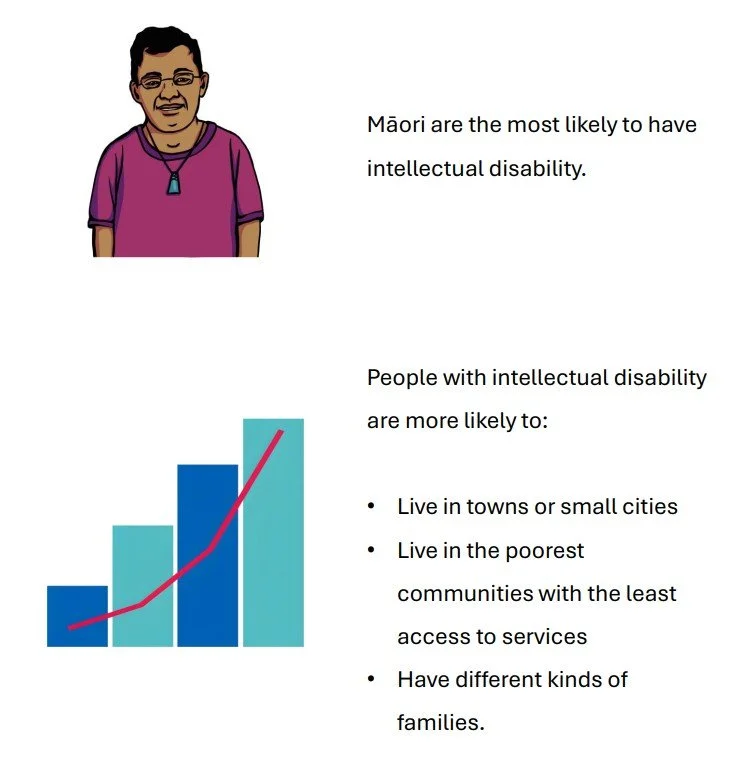
A section from the Easy Read version of the From Data to Dignity report
While the findings overwhelmingly show disadvantage, they also offer evidence of what is possible. The data includes people with intellectual disability who:
Complete school and attain qualifications
Are employed and contributing to their communities
Live in stable housing and supportive family environments
Have strong social connections and low involvement with justice or care systems
These outcomes are not rare anomalies—they reflect what can be achieved when individuals have access to the right supports, environments, and opportunities. The variation in outcomes across individuals and population groups highlights that intellectual disability does not inherently determine poor wellbeing. Rather, the disparities reflect how society is structured, how services are delivered, and whether people are included, valued, and supported.
IHC’s related report, The Cost of Exclusion, which explores hardship experienced by people with intellectual disability and their families, is also available here.
This report is part of a wider program of analysis using IDI data, with further publications forthcoming on employment, education, justice, and outcomes for Māori.
Post moderated by Sophie Yates.